
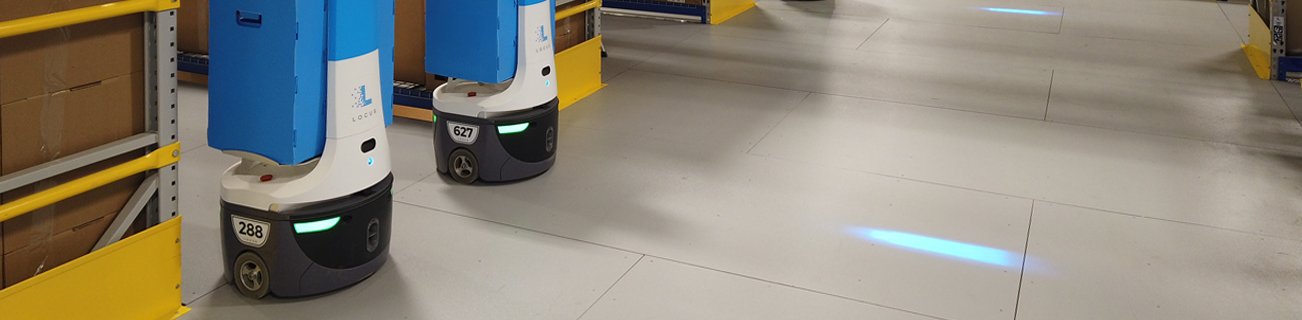
When planning new robot-ready warehouse flooring, expanding a facility, or adding an elevated platform, you might overlook the warehouse floor. People often focus first on the equipment they see in use. This includes racking, conveyors, automated guided vehicles (AGVs), and autonomous mobile robots (AMRs).
If your facility is preparing for automation, flooring for robotic traffic is part of the operating environment. Its condition can influence how effectively an AGV or AMR accelerates, stops, turns and navigates. On an elevated platform, in particular, the flooring specification deserves attention well before the first robot arrives. Sound automation planning should begin with the floor before the fleet.
The Flooring Decision Comes Earlier Than You Might Think
When evaluating flooring, many facilities teams focus first on whether it can support the requirements of the environment. That is essential, but robotic operations often demand much more.
A floor also has a working surface. This surface will interact often with robot wheels, navigation equipment, and repeated travel paths. Coefficient of friction, surface roughness, floor flatness, gloss, and wear can affect an AGV’s or AMR’s performance. The Finish Performance Matrix and Flooring Load Tables for Robotic Traffic identifies all five traits as relevant to flooring performance. According to the document, independent labs and robotic manufacturers test flooring products against established ASTM standards.
These characteristics will not be identical for every fleet. Robotic warehouse flooring should consider both AMR and AGV flooring requirements, as AMRs use lidar and can travel along different routes, whereas AGVs follow a fixed, highly repetitive path.
Robot size, payload, wheel material, contact pressure, navigation system and expected traffic volume all need to be considered.
Bringing your robotic manufacturer into the conversation early is important. The automation team should provide requirements before the team fully specifies and installs the floor. The facilities team, structural engineer, integrator, flooring manufacturer and robotics supplier should work from a shared understanding of the industrial flooring application.
In practical terms, the questions should include:
- What type of robot will operate on the floor?
- Will it use lidar, fiducials or another navigation method?
- Will its travel path be variable or fixed?
- What are the combined robot and payload loads?
- What wheel type will you use, and what contact pressure will you apply?
- What flatness, friction and reflectivity limits does the robotic manufacturer specify?
- Is an electrostatic dissipative surface required?
Answering those questions during design is usually easier than adapting the floor after selecting the fleet.
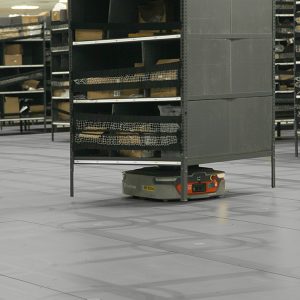
Friction, Roughness and Flatness Affect Every Journey
This is particularly important on an elevated floor. Choosing a suitable top surface is not enough if the supporting structure, decking, or installation adds irregularities. Design and install the complete floor assembly for the intended traffic.
ResinDek panels feature a tongue-and-groove configuration designed to promote panel-to-panel wheel-load transfer. Panel selection, support spacing, and substructure requirements should be determined based on anticipated loads and project conditions.
Gloss, Navigation and Wear Are Part of the Same Specification
Modern warehouse robots rely on more than wheels. Their navigation systems may use lidar, lasers, cameras, floor markers or fiducials. That means the optical properties of the floor matter as well.
A glossy or highly reflective surface may not suit every navigation system. Conversely, a finish that becomes patchy as it wears may create a less consistent visual environment. The robot manufacturer should confirm their needs for color, gloss, and light reflectivity before choosing the floor finish.
Wear resistance should also be considered. An AGV following a defined route will repeatedly accelerate, brake, turn and pivot in the same locations. Loading points, junctions and charging areas may receive substantially more traffic than the rest of the floor. AMRs may distribute traffic more widely, but their combined number of passes can still be considerable.
This is where the phrase “fit for robotic traffic” needs more detail. A surface that works for occasional foot traffic or manual equipment may not suit a high-frequency robotic route. The specification should reflect the actual navigation method, traffic pattern and expected number of passes.
ResinDek offers three relevant robotic surface options:
TriGard ESD
For AMRs using lidar navigation and variable travel paths.
TriGard ESD Ultra
Intended for more repetitive robotic traffic, including AMR and AGV applications using fixed paths or fiducials. Designed for applications where the frequency and concentration of traffic require greater wear resistance. The coating can also be adjusted for surface roughness and light reflectivity according to project requirements.
MetaGard SST
Is a stainless-steel surface made for severe wear. It suits fixed-path AGV use and areas with debris. It also works where pivoting or heavy traffic creates demanding conditions.
The correct choice depends on where the robots travel, how they navigate and what happens in each operational zone. For example, a project may benefit from one surface across variable AMR routes and a more wear-resistant finish in heavily used turning or transfer areas. Consult a ResinDek Expert to learn more about the right industrial flooring for your application.
The flooring and robotic manufacturers can help determine whether that kind of zoned approach is suitable.
Damaged Concrete Can Become an Operational Constraint
Concrete is familiar and widely used in warehouses, but familiarity does not remove the need to assess its condition. Uneven areas, cracks, spalling, repairs and changes in surface texture can all introduce inconsistencies.
For an existing facility, the challenge is not simply whether concrete can be repaired. Whether the repaired surface will have the characteristics required by the fleet.
Grinding may address a local high point, but it can also create dust and change the surface texture. Patches may not match the surrounding floor. New toppings and field-applied coatings require installation and curing time, and the resulting surface still needs to be evaluated against the robot manufacturer’s requirements.
Worn or uneven concrete can disrupt laser sensors and slow robot travel. The advantage of using ResinDek® Flooring over concrete can save your operation from costly downtime and concrete repairs.
This does not mean concrete floors cannot work with robots. Robot performance depends on the robot, software, wheels, payload, floor design, installation, maintenance and operating environment.
The practical point is that facilities teams should not assume a floor is suitable. A floor may have carried conventional warehouse traffic. Review transitions, joints, repairs, turns, and busy areas before deploying robots.
For ground-floor applications where the existing surface is unsuitable, ResinDek panels can be installed over concrete. This applies when the existing floor and project conditions meet the installation requirements. These requirements must match the robotic manufacturer’s flatness specification.
Design For the Fleet You Plan to Operate
Whether you are developing a new distribution center, extending a fulfillment facility or adding an elevated platform to a warehouse, the most useful time to discuss robotic flooring is before construction is complete. Start with the operating plan rather than with a generic flooring category.
Ask your robotic manufacturer to document wheel type, flatness tolerance, coefficient-of-friction requirements, navigation method, reflectivity requirements. Then share that information with the flooring manufacturer, structural engineer and integrator.
Finally, plan for how the floor will be maintained once the facility is operational. Dirt and debris can affect wheels and increase surface wear, particularly where robots pivot or follow concentrated paths. Cleaning access, inspection routines, and the ability to repair or replace damaged areas should be planned early.
Flooring may not make every automation challenge disappear. but it can provide a more deliberate, consistent foundation for robotics and can help facilities avoid preventable problems from unsuitable or damaged surfaces.
Before signing off on a mezzanine, elevated platform, or warehouse refurbishment, take one more look down. The floor might not be the most noticeable part of your automation investment. However, every vehicle in your fleet will depend on it.
Planning a robotic warehouse or elevated platform? Speak with a ResinDek expert to review your intended robot type, traffic pattern, loads and surface requirements, explore ResinDek panels with TriGard ESD, TriGard ESD Ultra and MetaGard SST finishes, or contact our sales team to discuss your project.
Ready to Learn More?
The right flooring choice today can help protect operational performance, minimize future maintenance concerns, and deliver long-term value for years to come.